Civil Drafting Course for Law Students and Young Lawyers
Free
Description
VIDHIGYATA · Practical Legal Skills
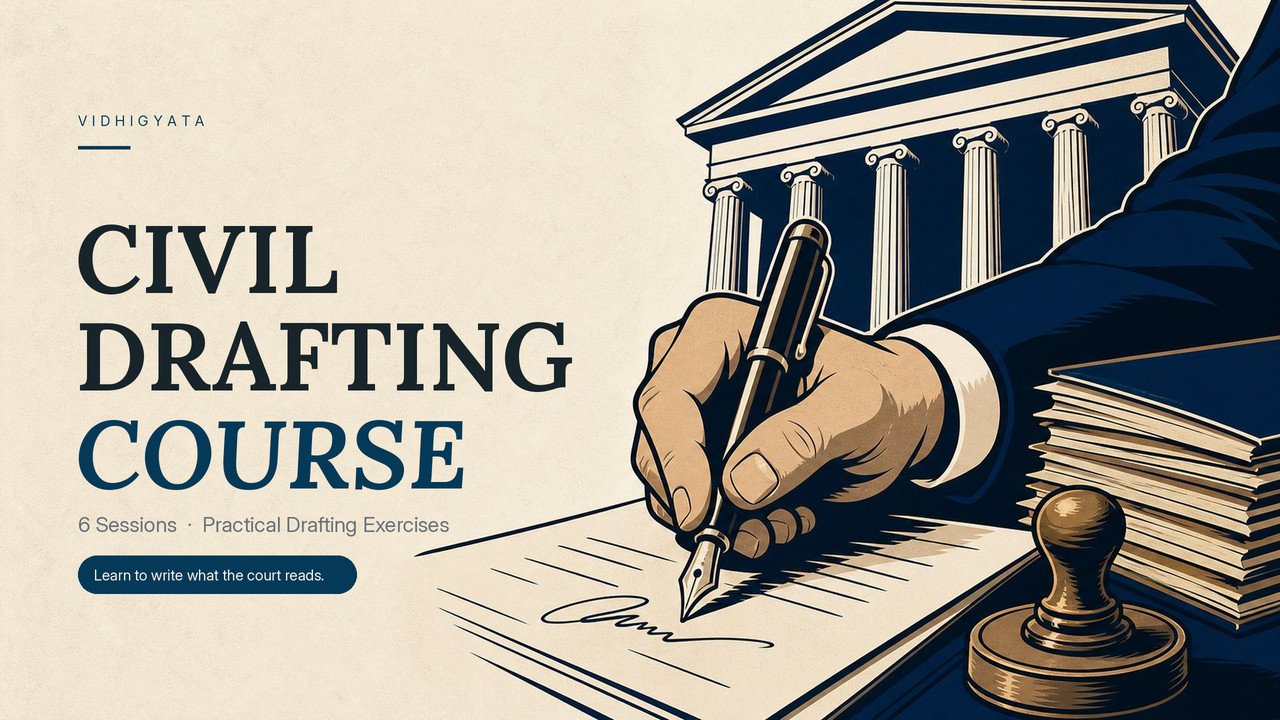
Civil Drafting Course
Learn to write what the court reads.
Litigation is won on paper long before it is argued in court. This course teaches civil drafting as a working skill — the structure, the language and the procedure behind the documents a civil practice runs on, each session paired with a practical drafting exercise.

6 SessionsPractical ExercisesDraft-Ready TemplatesCertificate
Why this course exists
Law school teaches the law.
It rarely teaches the document.
The skill nobody teaches on time
Drafting sits at the centre of every civil matter — and almost no law school teaches it as a practical skill. Students graduate able to name the sections and unable to actually draft the document.
Internships judge you on it
Chambers and courts test you on your first draft, not your first impression. A well-drafted notice or plaint is the fastest way to be trusted with real work.
One error costs the client
A defect in valuation, jurisdiction or verification can lose a case before the merits are ever heard. Precision is not a stylistic preference here.
It has to become muscle
Drafting is learned by writing, correcting and rewriting — which is why this course pairs every session with a practical exercise rather than only theory.
The Curriculum
Six documents.
One method behind all of them.
Each session takes one document, breaks down its anatomy, and rebuilds it from the ground up.
Session
01
The Principles of Civil Drafting
Drafting is the part of legal practice no classroom teaches well. This session sets the foundation: what separates a pleading that persuades from one that merely records facts, the anatomy every civil draft shares, and the language, structure and precision the profession expects.
What it covers
- Foundations of civil drafting as a professional skill
- The essential elements every civil draft must contain
- Structuring a document so it reads logically
- Precision of language: choosing the exact word
- The standard traps that weaken a draft
- How to build a drafting habit that scales
Session
02
Legal Notice
The document that starts most civil litigation — and decides whether the matter settles or escalates. You will learn how a notice is constructed so that it creates a clean cause of action, fixes the timeline, and leaves the recipient no room to claim they were not told.
What it covers
- Meaning, purpose and legal effect of a notice
- Essential components and standard format
- Drafting the demand so it stands up later
- Timelines, service and proof of delivery
- Practical drafting exercise
- Common mistakes that defeat a notice
Session
03
Affidavit
An affidavit is sworn evidence, and a defect in it can undo everything built around it. This session covers how to draft one properly — from the opening identification of the deponent to the verification clause that gives the document its legal force.
What it covers
- Meaning, use and importance of an affidavit
- Essential elements and correct format
- Drafting the statement of facts clearly
- Verification and attestation procedure
- Who may swear, and how it is executed
- Common errors and practical tips
Session
04
Money Suit
A money suit is bread-and-butter civil litigation, and it is where procedure earns its keep. This session works through the plaint in a suit for recovery — valuation, jurisdiction, court fees, limitation and the clauses that protect the claim from a preliminary objection.
What it covers
- Concept and essentials of a money suit
- Jurisdiction, valuation and court fees
- Limitation and how to plead it
- Structure of the plaint and its key clauses
- Drafting technique and supporting documents
- Common mistakes that sink a recovery claim
Session
05
Divorce Petition
Family law drafting demands a different discipline: facts stated with restraint, grounds pleaded with specificity, and a petition that survives scrutiny under the statute it is filed under. This session works through the divorce petition end to end.
What it covers
- Fundamentals of a divorce petition
- Grounds for divorce and how to plead them
- Essential clauses and the drafting format
- Jurisdiction and legal requirements
- Practical drafting tips
- Common mistakes and how to avoid them
Session
06
Sale Deed
A sale deed is where property actually changes hands, and every clause in it has to survive being read years later by someone with an interest in disputing it. This session works through the deed from the parties and recitals to registration.
What it covers
- Identifying the parties and establishing title
- Recitals and the property description
- Consideration and how payment is recorded
- Operative words of transfer and covenants
- Stamp duty and registration requirements
- Defects that turn a completed sale into litigation
By the end, you are not memorising formats. You are drafting.
Every session closes with a practical exercise, so the document is in your hands — not just in your notes.
You may also like…
-
Sale!

FOUNDATIONAL CERTIFICATE COURSE – AI FOR LAW STUDENTS AND LEGAL PROFESSIONALS
Original price was: ₹4,000.00.₹249.00Current price is: ₹249.00. -
Sale!